Yogurt to the Beans
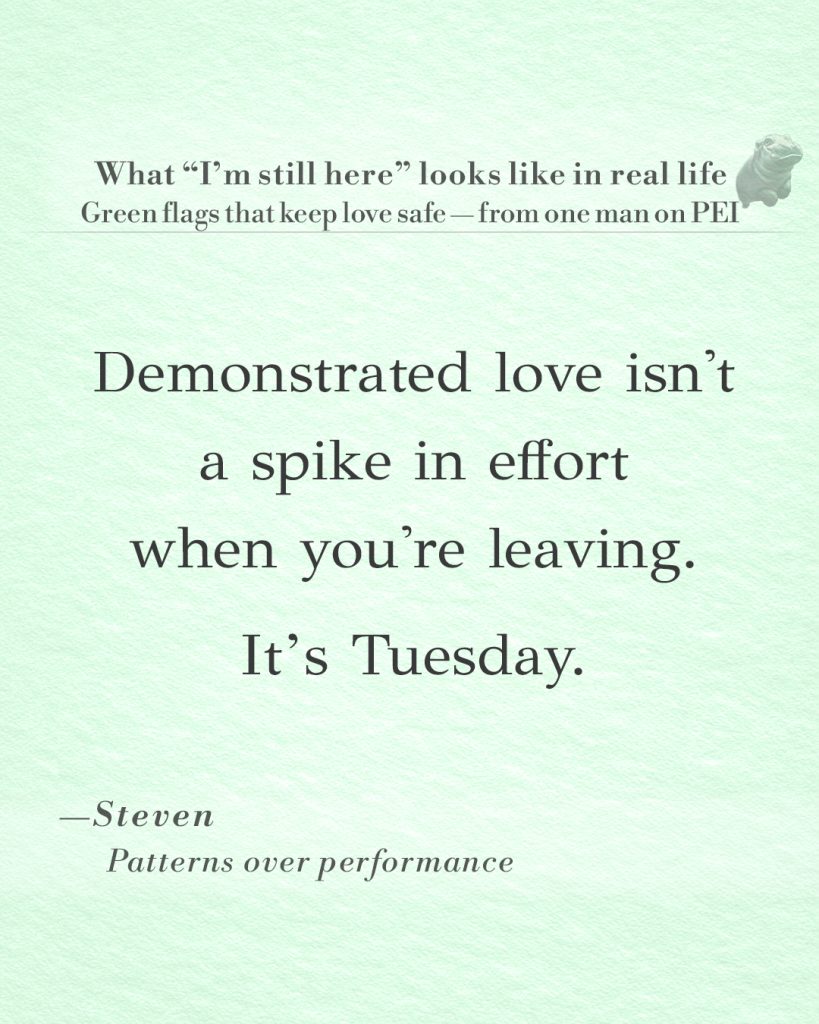
To me, healthy love doesn’t look like a cycle of panic and grand gestures. It looks like a steady rhythm of small, ordinary evidences. It’s the regular heartbeats of showing each other we’re each’s other in all the small ways.
Not a dozen roses because I’m “in trouble,” but materializing back at the cart while you’re contemplating beans, holding your favourite yogurt we both forgot in the dairy aisle.
Even on a Tuesday.

Behind the Wires
Personal Notes
Stay with me here… this one’s a little bit strange.
I was studying poetry—the psychology and math of how a sentence lands—and I realized that I’m a gorilla. Not a chimp, and not even an orangutan, which is what I would have guessed.
There is a field of study called Neurocognitive Poetics: the science of how the brain experiences literature and poetry. Good writing isn’t just informative; it actually feels good to read. Literally. In fact, it’s for the same reason music feels good. And it has to do with how humans learned to communicate as we developed language, singing, and dance—it was to affirm to ourselves and our tribemates that we belonged with each other. That we belong to each other.
I tumbled down a long, twisty, and fascinating rabbit hole courtesy of the Max Planck Institutes of science. They’ve found why humans are one of the few animals that truly “vibe” with music and poetry. It’s because our brains are such obsessed pattern-matching machines that when we hear rhythm, we predict what the next beats will be. When those beats come as expected, our brains reward us with a tiny release of dopamine—because we were so smart, bobbing our head to the music like that.
This likely developed to help us communicate faster as hunter-gatherers. It helped coordinate the hunt. It also allowed us to process the intent of the person talking to us without having to wait for every single word to finish before we knew whether to run, hit, or hug.
A chimpanzee can slap on a drum, but they can’t follow the drum-slapping of another chimp. They can’t “lock in” to that beat and anticipate the next thump. Humans, though, are amazing at this.
What scientists at the Max Planck Institute for Empirical Aesthetics have worked out, is that this ability to pattern-match and detect rhythm in speech, writing, and movement is the actual seed of human empathy. It’s what allows us to ‘mirror’ someone’s expression in our mind, and feel what they’re feeling… and to imagine them feeling what we’re feeling.
It’s more than just a vibe; it’s neural coupling. That dopamine reward for ‘locking in’ is the mechanism that physically synchronizes our internal states, turning a predicted beat into a shared emotion.
This made me think of our cousins—the fellow hominids of us hominins (the fellow great apes of us humans).
When a human infant tastes something yummy, they will often offer some of it to a loved one so that person can share the same pleasure. Researchers found that baby chimpanzees do this, too, though for a slightly different reason than we do. Orangutans, on the other hand, do not. Give a baby orangutan a treat and they will snatch it out of each other’s hands and gobble it all up for themselves.
This makes evolutionary sense. Orangutans are solitary; they survive on their own wits and muscle. If they don’t get what they need for themselves, they die. Humans and chimpanzees, though, rely on society. We both practice politics and complex relationships to determine who are allies and who are enemies. We will even work out who are the allies and enemies of our enemies and allies. With us and our chimpy cousins, understanding that others feel pleasure or hurt like we do is a survival strategy. If we don’t get what we need for ourselves, our tribemates can give from theirs. This is altruism. We want to alleviate the suffering of others because we can imagine what it feels ourselves.
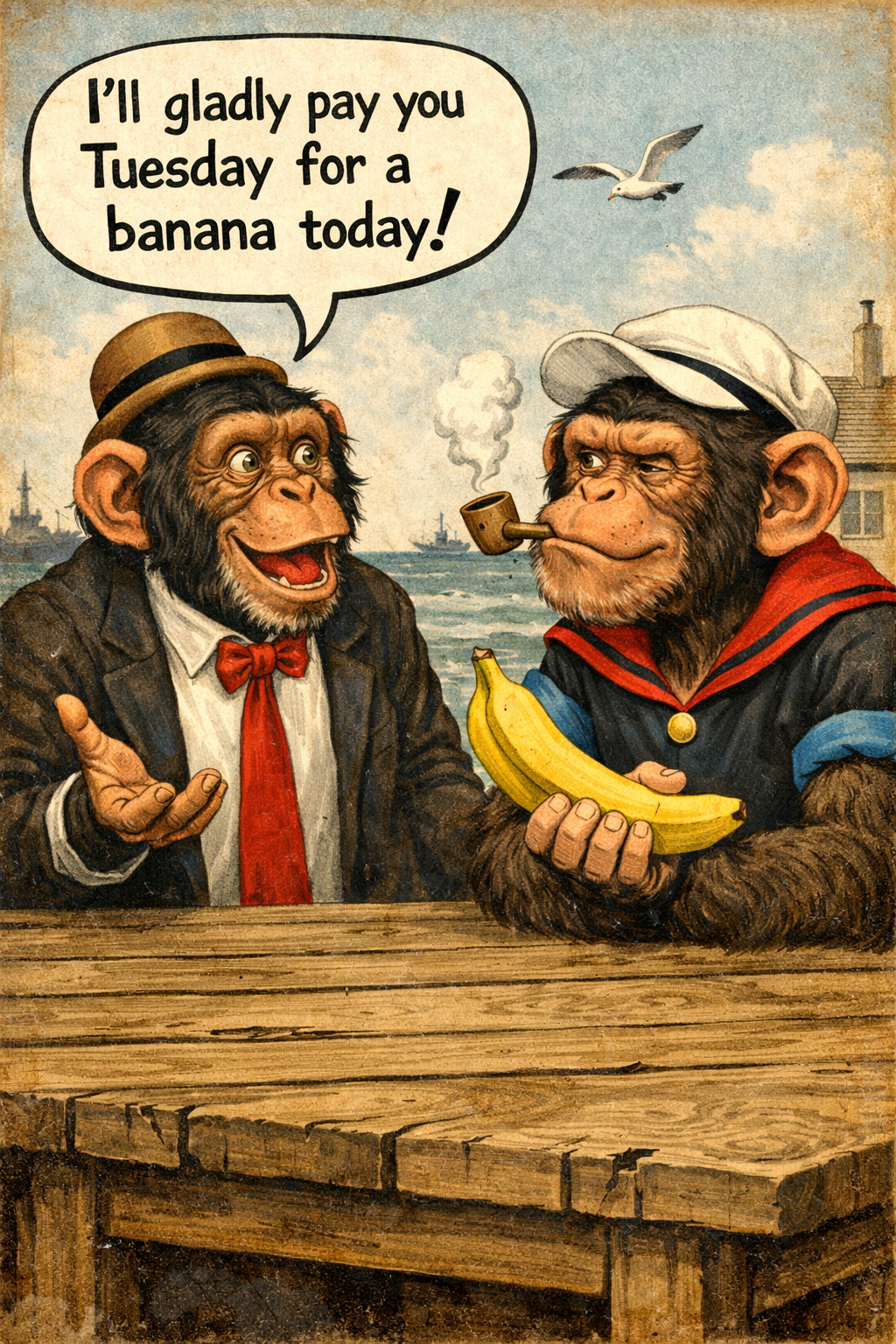
For chimpanzees, though, it is often more transactional. It’s a “you scratch my back; I’ll pick the ticks off of yours” situation. Or an “I’ll gladly pay you Tuesday for a banana today” sort of deal. They will even offer goodies to strangers to earn a new friend. There is a social ROI (Return on Investment) attached to their kindness.
Infant gorillas behave somewhere in the middle. They share with the loved ones they see as family and trusted friends. Unlike chimpanzees, gorillas do not form complex, multi-tiered societies of soap operatic relationships, betrayals and wage chimp wars. Instead of forming a community like chimps, gorillas travel as a family unit. There is no strife because they are not competing or trading favors to get something in return. When they share, it’s out of familial bonds—a literal act of love and devotion instead of a transaction.
So we have:
- Orangutans: The brilliant, solitary engineers who scarf down the treat alone.
- Chimps: The high-drama politicians swinging sticks for social swagger.
- Gorillas: The family troupe where the goal isn’t rank—it’s integrity.
I realized that’s my internal OS. I’ve watched men my whole life swing sticks and puff their chests to earn a “status” and orient themselves in relation to the other men around them—something I honestly couldn’t care less about. If someone wants to declare themselves the king of an asinine competition, I’ll usually just step aside and let them have their paper crown. It’s not passivity; it’s just that their noise doesn’t match my rhythm.
The Silverback is the most gentle soul in the jungle. He’ll let infants crawl all over his head and pull his ears. He, and those he protects, rely on his bulk—his presence. He doesn’t need to perform acts of aggression; he’s a deterrent, by his very nature of existing. He is the steady rhythm that allows everyone else to feel safe.
But there’s a tripwire.
A gorilla may or may not offer you a piece of his favourite fruit, but he will literally die to make sure his family can eat theirs in peace. To gorillas, there is nothing more detestable than injustices done to the vulnerable. When I see someone punching down—ridiculing the weak, mocking the victim, or treating the helpless with contempt—I don’t just lose my patience; I lose my capacity to see them as a person deserving of dignity, and I can feel my body prickling all over in directed rage.
In that moment, I see through their veneer of humanity completely. They are no longer a peer. A fellow person. I won’t even share my piece of fruit with them! I don’t see a “difference of opinion”; I see a predator in the nursery. It sets me off like the structural collapse of an angry building.
Those are the suits I wear. Gorilla—dog—human. I’m not here to swing sticks for a rank, or use my strength for show or politics. The toughness of my silverback suit is what affords me the luxury of a Golden Retriever heart, with a man’s snark and rhythm. It means I can afford to be gentle, to touch with measured softness, and to walk the long trails with my world walking beside me—because my ‘bulk’ is holding the perimeter. I’m here to be the wall against the wind, so the people I love can just… be.